Institutional Blind Spots
and the Forensic Reckoning
The Auction House
as Historic Arbiter
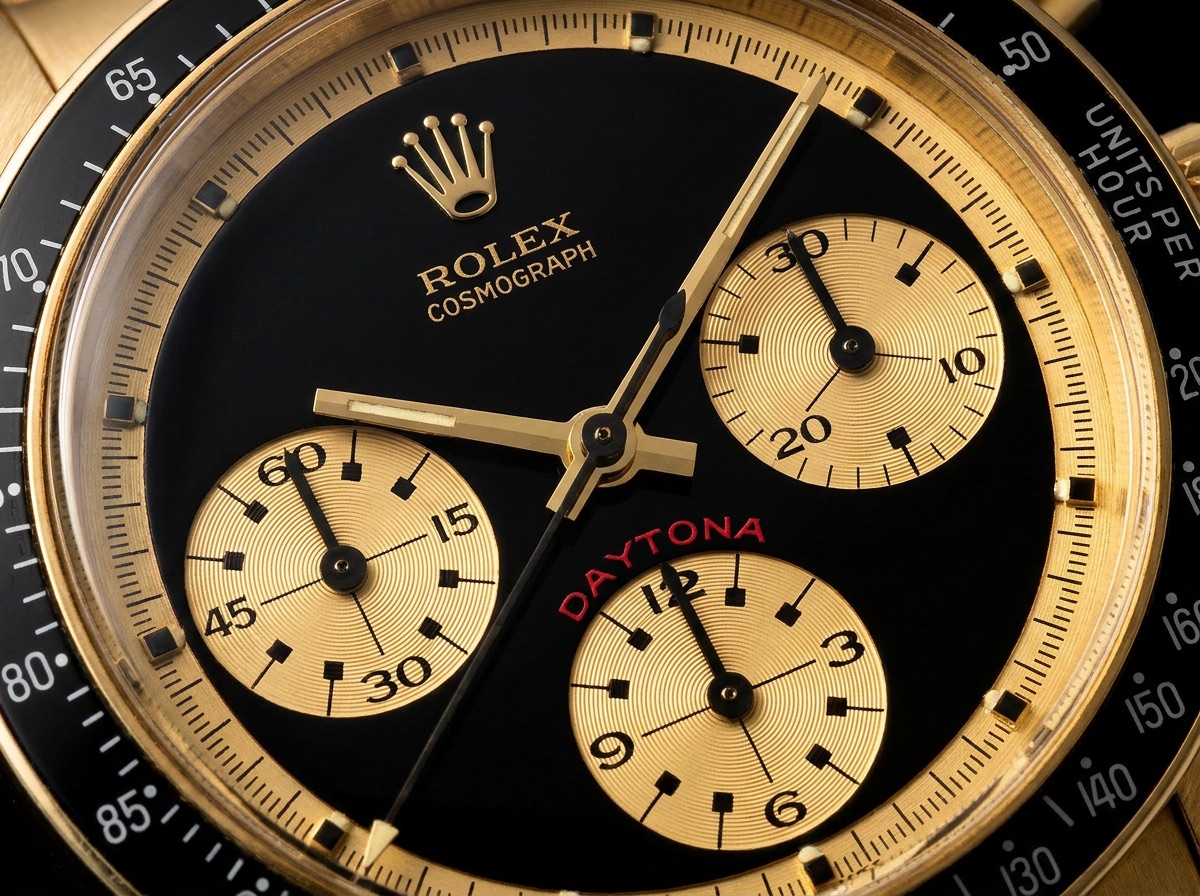
In the rarefied domain of investment-grade horology, provenance has become the decisive variable that separates standard assets from terminal wealth compounds. A standard manual-wind Rolex Daytona trades in the $40,000–$50,000 band; the identical mechanical architecture, when crowned with a verified Paul Newman “Exotic” dial, re-rates immediately to $150,000–$175,000. With up to 90 percent of equity concentrated in marginal visual signatures, the incentive to fabricate rarity is structural. Collectors outsourced authentication to premier auction houses and manufacturer heritage departments—entities positioned as impartial arbiters of historical truth. Yet a forensic examination of recent market cycles reveals these institutions occasionally amplify rather than mitigate risk, legitimising sophisticated composites and transferring asymmetric exposure directly onto the buyer.
The “Halo Effect” and Institutional Risk Transfer
The mechanism is behavioural. When a potentially compromised Frankenwatch appears in a gilt-edged auction catalogue or bears an “Extract from the Archives,” it acquires an institutional halo. Bidders anchor on the prestige of the house rather than the object’s physical evidence, subconsciously discounting forensic red flags. Auction economics reinforce the dynamic: buyer’s premiums and record-hammer prestige incentivise volume at the top end. Legal architecture—Caveat Emptor clauses and exhaustive Conditions of Sale—systematically shifts authenticity risk to the purchaser. The auction house authenticates narrative; the collector bears the capital consequences.
This risk transfer is not incidental but cultural. As vintage horology completed its transition from wearable instrument to Veblen ATA, participants increasingly priced institutional endorsement above intrinsic verifiability. The result is a market where cultural authority can temporarily override material reality, widening spreads between verifiably original specimens and those resting on borrowed prestige.
The Transmutation of Anomalies: The “Black Ghost” ROC
Few episodes illustrate the auction house’s power to reshape market reality more starkly than Christie’s 2014 sale of the “Black Ghost” Rolex Daytona. The watch displayed conspicuous anomalies: mismatched patina, altered surface porosity, chemical staining, and a contested “ROC” dial typography. Under trademark precedent, non-factory alterations typically render a vintage Rolex valueless as counterfeit. Instead, Christie’s advanced a narrative framing the dial as an authentic factory modification by Jean Singer & Cie, attributing overpainting to “human error” corrected in-house. Despite vigorous pushback from independent forensic researchers, the house cited verbal confirmation from Rolex Geneva. The watch realised CHF 461,000.
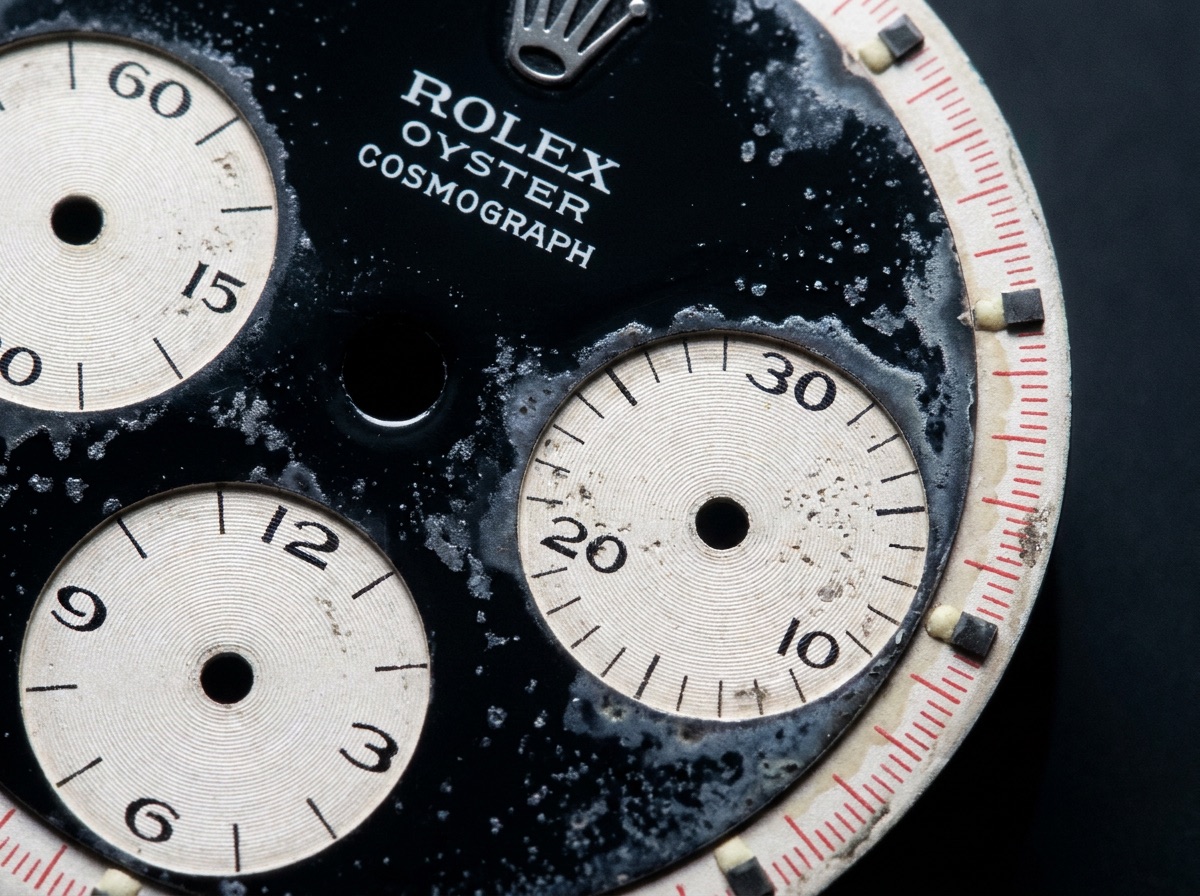
By reframing defects as markers of unique provenance, the auction house transmuted potential forgery into rarity premium. The episode compelled the broader market to price heavily reworked dials as investable anomalies, demonstrating how institutional narrative can override physical evidence and recalibrate collective valuation baselines. Trust in the arbiter temporarily hardened a new, higher price floor for exceptional—but contested—variants.
The Archival Blind Spot: Omega Museum Infiltration
The assumption that manufacturer heritage departments remain impregnable was shattered in November 2021. Phillips offered an Omega Speedmaster Ref. CK 2915-1 “Broad Arrow” with tropical dial for a world-record CHF 3,115,500, supported by an official Extract from the Archives. Subsequent Omega investigation exposed a sophisticated Franken assembly featuring a counterfeit escapement wheel bridge and fabricated serial. Three former employees, including the Head of the Omega Museum and Brand Heritage, were implicated in manipulating internal archives to legitimise the construct.
The scandal exposed a critical vulnerability: even institutions with proprietary data can be compromised when economic incentives align. Cultural deference to archival authority had permitted a high-value fiction to command institutional price levels. Upon exposure, the episode reinforced a permanent discount for any asset whose provenance rests solely on potentially mutable institutional records, tightening the market’s overall authenticity moat.
The $3.1M Inside Job
In November 2021, the structural vulnerability of the institutional arbiter was exposed in unprecedented fashion at the Phillips Geneva Watch Auction. Lot 53 was presented as an exceptional, first-generation 1957 Omega Speedmaster Ref. CK 2915-1 “Broad Arrow,” featuring an evenly aged “tropical” milk-chocolate dial.
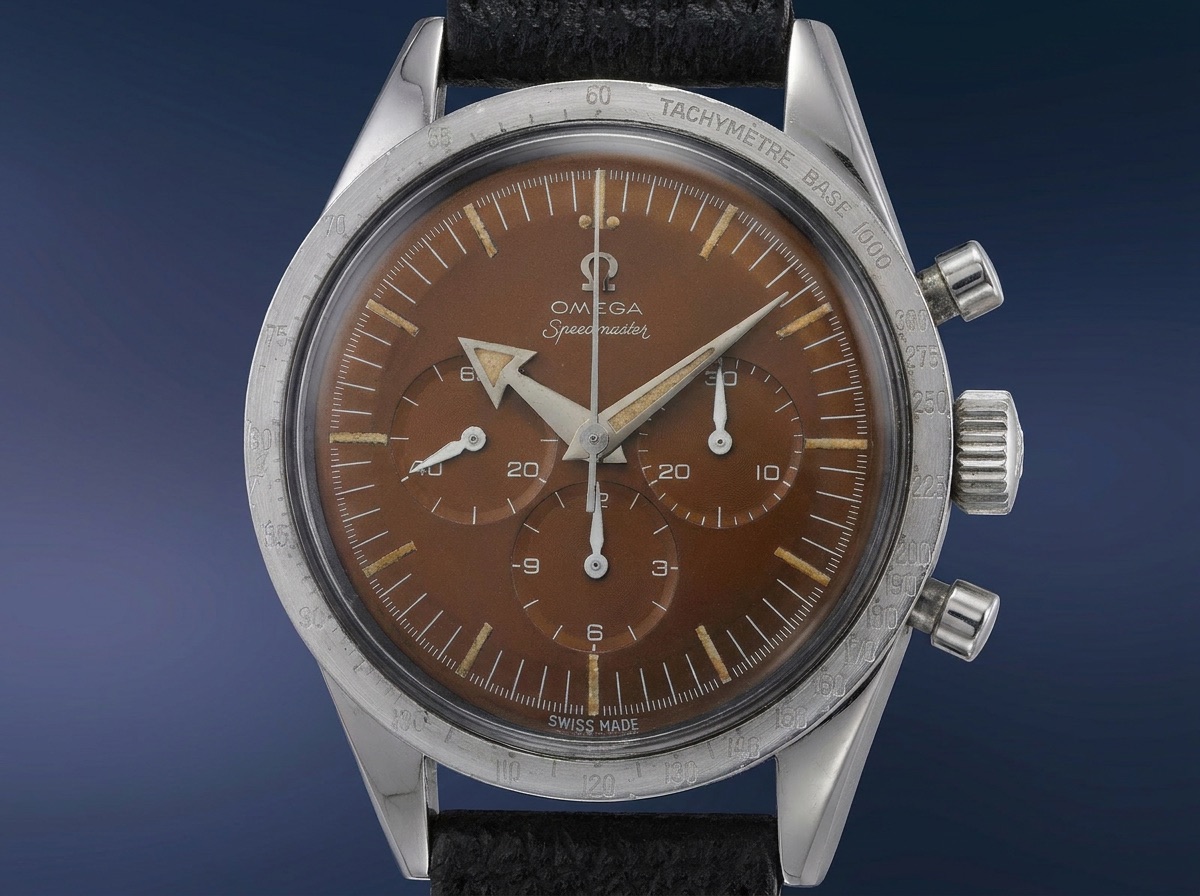
Bolstered by aggressive marketing and accompanied by an official “Extract from the Archives,” the asset hammered for a staggering, record-breaking CHF 3,115,500. This result seemingly validated the absolute supremacy of institutional provenance, pricing the watch as a terminal “grail” asset.
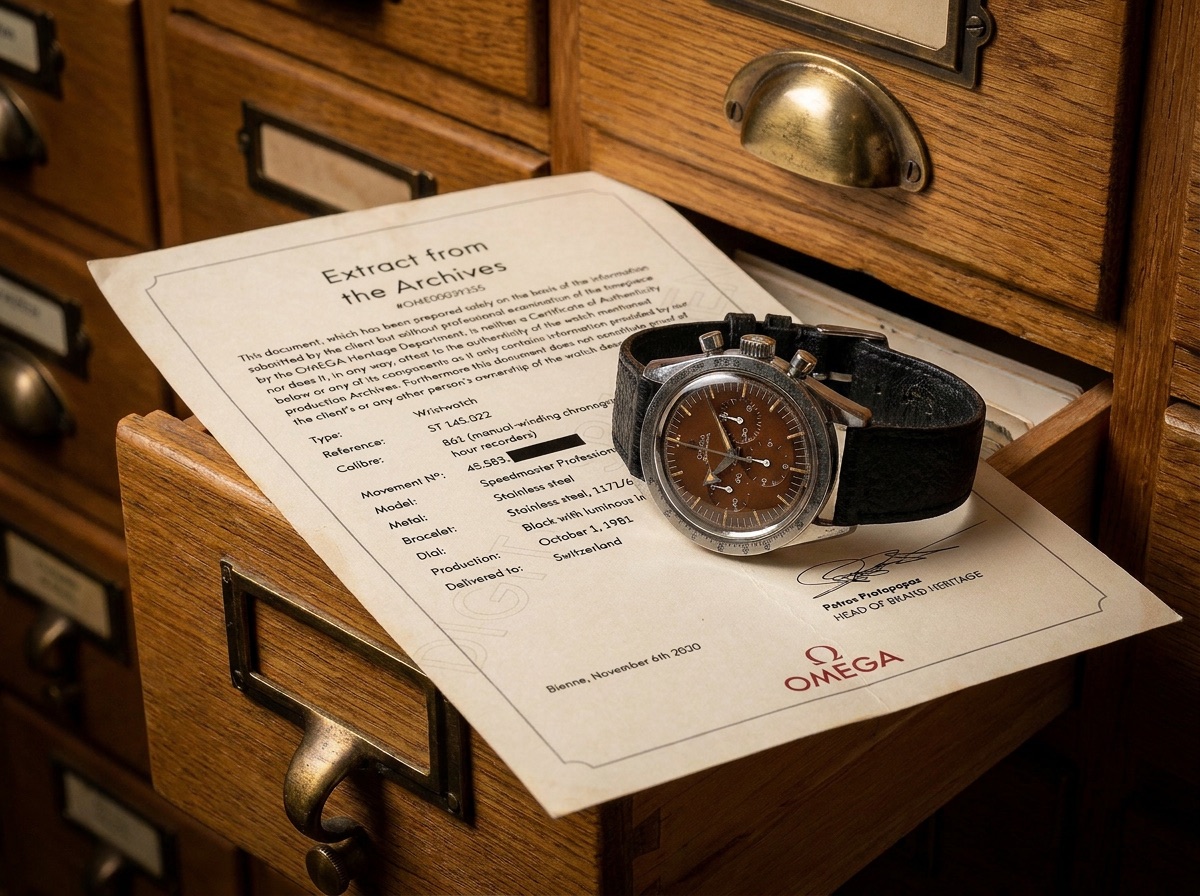
However, this institutional halo was swiftly shattered by independent data-driven forensics. Horological researcher Jose Pereztroika (Perezcope) systematically deconstructed the asset, stating unequivocally, “The watch is an assemblage, a Frankenstein watch, that did not leave the Omega factory like that.” The technical teardown revealed a staggering level of physical manipulation. The dial’s original greenish luminescence had been chemically darkened to simulate natural vintage aging, while the caseback bore an anachronistic Seahorse logo impossible for its purported era. Most damningly, micro-scratch analysis definitively proved that the solid steel tachymeter bezel had been stolen from a later Ref. 2915-2 that Phillips had previously auctioned in 2018.
The mechanical heart of the fraud represented a severe escalation from opportunistic part-swapping to outright horological identity theft. Forgers utilized a later-production Calibre 321 movement (originating in the 25-million serial range) and removed its original escapement wheel bridge. In its place, they grafted a newly manufactured, counterfeit bridge precision-engraved with the highly coveted archival serial number 15500066.
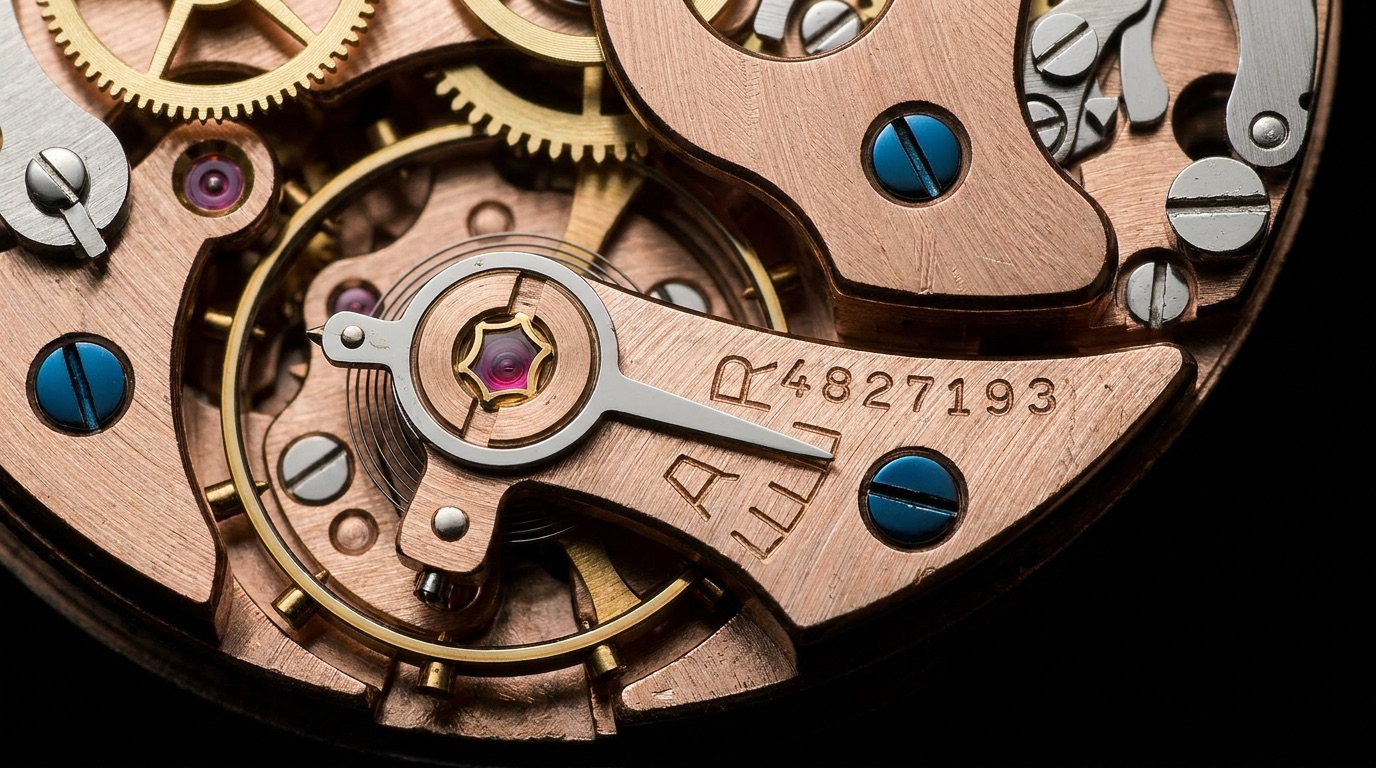
This caliber of deception was not the work of isolated gray-market actors; it was facilitated by direct institutional corruption. Internal investigations by Omega confirmed that a criminal conspiracy existed within their own walls, involving three former employees—including the former Head of the Omega Museum and Brand Heritage. These corrupt insiders provided external syndicates with the pristine 15.5-million archival serial number to legitimize the counterfeit bridge, and subsequently issued the official archive extract to fully launder the asset’s provenance.
In the ultimate, devastating paradox of the thematic auction ecosystem, the victor of the intense bidding war was not a private collector, but Omega itself. The brand had aggressively deployed corporate funds to acquire the masterpiece for its official museum, meaning Omega unwittingly bought back a forgery engineered by its own former staff and laundered through a premier auction house. The episode serves as a permanent warning to horology investors: even the most prestigious archival paperwork is meaningless if the institution issuing it has been compromised.
Institutional Opacity and the Data Deficit
The proliferation of horological fraud is not solely a consequence of illicit ingenuity; it is structurally compounded by the deliberate opacity of the manufacturers themselves. In an era where independent forensics are the primary defense for capital preservation, elite brands frequently embargo the very data required to verify authenticity. Rolex, specifically, maintains a rigid corporate policy of refusing to cross-reference asset serial numbers against international stolen registers or verify original component configurations for secondary market participants. By denying the collector community access to this cryptographic baseline, the manufacturer enforces a severe information asymmetry. This institutional silence effectively acts as a systemic enabler, shielding illicit actors and allowing compromised Frankenstein assemblies to circulate unchecked through the global ATA ecosystem.
Bolt offers unsparing critique. He condemns the market’s paper fetish—“The market has gone bananas about papers”—and highlights how fraudsters deliberately renumber cases to match orphaned documentation, knowingly committing identity theft to capture premia. Bolt extends the indictment to manufacturers themselves, arguing that Rolex’s reluctance to cross-reference serials against stolen registers has shifted from neutrality to active hindrance, enabling rather than obstructing the proliferation of composites.
His stance crystallises a cultural-economic reality: as prices escalated, institutional gatekeepers—once trusted stewards—became participants in a theatre of provenance whose incentives are not always aligned with capital preservation. Absolute reliance on their endorsement has become a strategic liability.
Strategic Imperative for Investors
These episodes dictate a decisive recalibration. Capital deployment in vintage horology can no longer treat auction houses or heritage departments as final arbiters. They remain powerful market-makers and liquidity engines, yet their halo must be stress-tested against independent forensics: metallurgical analysis, serial-range databases, microscopic typography mapping, and unbroken chain-of-custody documentation.
Those who can internalise this reality gain advantage. They avoid assets whose value derives primarily from institutional narrative, favouring instead watches whose originality is multiply verifiable—physically, archivally, and culturally. In doing so, they capture the most resilient price floors: those anchored not in borrowed prestige but in forensic impregnability.
The auction house as historic arbiter reflects a deeper truth. Cultural authority consolidates around institutions precisely when information asymmetry peaks. Yet history demonstrates that such authority is contestable. As digital forensics and independent research proliferate, the premium for genuine, unassailable provenance hardens, while reliance on potentially captured gatekeepers imposes widening discounts. Institutional endorsement should be treated as valuable context rather than conclusive proof in order to invest in the most secure horological assets.
In an era of monetary abstraction, the watches that endure as stores of value are those whose stories withstand every layer of scrutiny. Protecting that integrity demands moving beyond institutional halo to rigorous, multi-vector validation—the only durable discipline in a market where even arbiters can err.
The Perezcope Era of
Epistemological Mastery
The romantic foundation of vintage watch collecting, once captured in the reassuring axiom “buy the seller”, has collapsed under the weight of its own contradictions. The vintage landscape now demands a decisive intellectual pivot. Subjective consensus from dealers, auction specialists, or heritage departments has proven too easily compromised. Authenticity is no longer a bestowed reputation but an engineered certainty extracted through data mastery and material science. This transition, crystallised in what we term the Perezcope Era, has redefined how collectors price risk, establish liquidity floors, and protect the integrity of their holdings.
The Demise of the “Buy the Seller” Paradigm
For generations the market operated on relational trust: elite dealers, auction houses, and physical documentation formed an implicit safety net. That network fractured publicly in 2014 when prominent collector John Mayer pursued a high-profile lawsuit against veteran dealer Robert Maron, alleging the supply of Frankenwatches fitted with fabricated “Texas” dials on early Daytonas and Submariners. The case laid bare that even the most respected gatekeepers could be compromised.
The mechanics of the “Texas” dial reveal a sophisticated attempt to bypass superficial dealer inspections by weaponizing authentic base materials. Counterfeiters sourced genuine, low-value standard Rolex Daytona dials, chemically stripped the original paint down to the authentic brass base plates, and applied a fraudulent “Paul Newman” pad-printed (décalque) overlay. Complicit auction houses repeatedly peddled these flat dials as exceptionally rare, authentic variations, injecting a persistent source of toxic provenance that contaminated the secondary market for over a decade.
Simultaneously, independent researcher Jose Pereztroika of Perezcope.com delivered the Panerai Papers investigation, exposing how master fabricators like Luciano Rinaldi produced prototype dials and re-engraved commonplace Rolex calibre 622 bridges to impersonate ultra-rare military variants such as the calibre 618 Type 1. These assemblies sailed through auction intake and dealer vetting, proving human judgement alone could no longer withstand industrial deception. Collectors who once relied on personal relationships or brand extracts found themselves confronting a contaminated market where provenance narratives required independent verification.
The Mechanics of Database Forensics
In response, a new discipline emerged: database forensics. Pereztroika assembled a proprietary archive of over 100,000 high-resolution images drawn from decades of catalogues, dealer records, and private collections. Rather than trusting aesthetic intuition, the method maps unrepeatable physical signatures, an asymmetrical scratch in a subdial, a singular oxidation bloom on a handset, a distinctive tool mark beside a lug. These digital fingerprints reveal exactly how components have been harvested, aged, and reassembled into historically impossible configurations.
Pereztroika’s archival material allows for precise historical comparison, exposing the vintage market’s structural opacity and collapsing the information asymmetry that had long protected manipulation. As the database reached critical scale, Pereztroika captured the transformation: “After a while I had everything. I saw through all the schemes. I knew which watch was manipulated and which was not. I knew who the major players were. I knew who the counterfeiters were.”
At the heart of the system lies “damage fingerprinting.” Instead of trusting easily forged paperwork or dealer assurances, the method follows immutable physical signatures: an asymmetrical scratch buried in a subdial, a bloom on a handset, or a tell-tale gouge beside a lug left by a slipped tool. When dismantling a purported Rolex Daytona “John Player Special” at Monaco Legend Auctions, Pereztroika matched a precise mark at six o’clock near the caseback across years of records: “The marks are absolutely matching.
This is like a fingerprint. No two watches have this in the exact same spot.
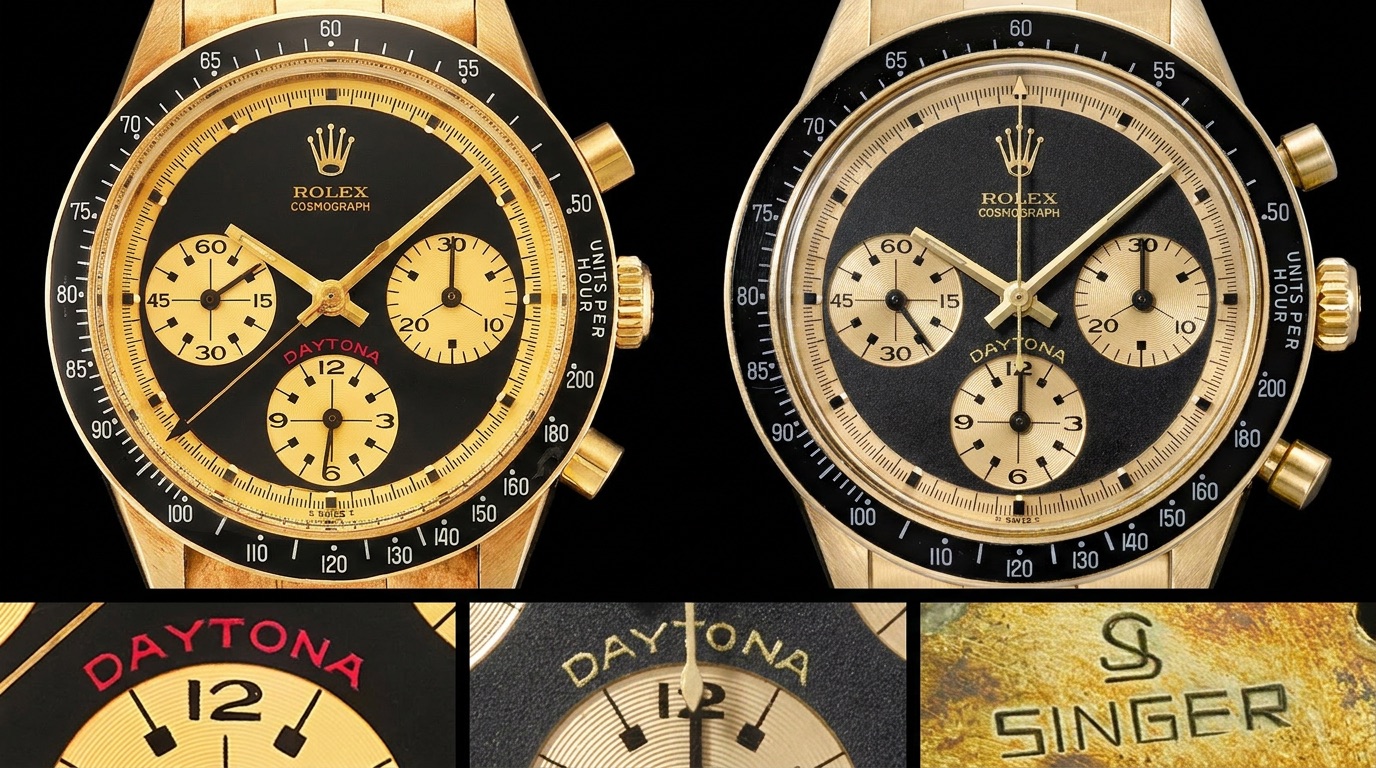
” The protocol traces exactly how components are harvested from donor pieces, chemically aged, and reassembled into historically impossible wholes.
The methodology extends to forensic typographical scrutiny and digital forensics. It dissects serif structures, printing clichés, and serial batches to expose timeline violations, such as period-incorrect “millerighe” pushers on a 1971 case whose brass core betrays earlier origins once plating wears.

It also unmasks institutional image manipulation: when Phillips was found enhancing catalogue photographs, Pereztroika isolated identical pixel clusters and artificial 3D drop-shadows cloned from pristine examples to disguise damage on offered inventory.
Applied at scale, this comparative discipline has compelled painful market corrections. His analysis of the $3.95 million Omega Speedmaster Ref. CK 2915-1 matched microscopic bezel dents to a different watch sold three years earlier, forcing the verdict: “The watch is an assemblage, a Frankenstein watch, that did not leave the Omega factory like that.” Tens of millions in contested lots were withdrawn or re-priced, establishing independent database forensics as the non-negotiable filter.
Bolt, with three decades of market immersion, credits these studies with ending casual part-swapping. “Due to the studious work of Jose at Perezcope,” he notes, “each few years they had differences in the dials and movements. They are subtle, and you wouldn’t really know, but they are there—the dial manufacturer, the printing fonts, different things.” The cumulative effect, Bolt warns, has turned the vintage sector into “a huge minefield.”
The New Epistemological Toolkit
Surface inspection has been superseded by a layered scientific arsenal. X-ray fluorescence spectrometry scans case metallurgy for non-original alloys or tungsten weighting. Micro-CT imaging cross-references internal architecture against factory blueprints, exposing geometric clones. AI micro-surface systems like TrustWatch detect nanoscale CNC chatter and engraving deviations invisible to the loupe. Acoustic fingerprinting, as patented by Rolex in 2025, analyses escapement harmonics to distinguish hand-finished resonance from cloned uniformity. Together these tools convert the collector’s due diligence from art into reproducible science.
Market Paranoia and the Tainted Provenance Crisis
The exposure of institutional blind spots has bred forensic vigilance. Collectors now insist on 7- to 30-day escrow periods and willingly absorb an “authentication tax” of $500 to $5,000 for independent audits. Assets lacking ironclad data trails suffer immediate 60- to 90-percent valuation collapse and near-total illiquidity. Conversely, watches that survive multi-vector scrutiny command widening premia and rock-solid liquidity floors. The metal itself has been commoditised; the verified data trail is the scarce asset counterfeiters cannot replicate at scale.
Bolt further illuminates systemic friction. Manufacturers such as Rolex, by refusing to cross-reference serials against stolen registers, have shifted from helpful to “active hindrance.” The resulting vacuum once inflated the paper premium, a phenomenon Bolt attributes to dealer shortcomings: “The reason why papers and boxes have had such premiums… is because most watch dealers haven’t got a clue what they meant to be looking for.” This misplaced faith spawned documentation forgery and outright identity theft—renumbering cases to match orphaned paperwork. Bolt’s verdict is absolute: “When you purposefully and knowingly alter the registration of a watch’s number, that is a fake watch.”
The Perezcope Era has elevated horological collecting from a trust-based pursuit into a rigorous, evidence-driven discipline. It has dismantled the comfortable illusion of delegated trust, stripping away dependence on middlemen and auction-house halos while elevating the collector who commands the forensic lens. Those who internalise this discipline sidestep the contaminated middle of the market and focus their holdings exclusively on specimens whose integrity can be proven beyond reasonable doubt—watches whose microscopic histories are digitally mapped, metallurgically verified, and acoustically fingerprinted.
In an age of shadow manufacturing and institutional opacity, the most enduring and rewarding pieces are no longer those whose stories are artfully told, but those whose stories are empirically, immutably confirmed. Each advance in independent verification widens the valuation chasm: pristine, data-anchored examples enjoy reinforced liquidity floors and compounding premia, while anything resting on narrative alone suffers accelerating discounts. That mastery is no longer a specialist’s edge. It has become the decisive discipline—the quiet advantage that separates enduring capital preservation from expensive cautionary tales.